

How to Upgrade Existing Analog Bus Camera Systems with Edge AI
Discover how the SINTRONES IBOX-601-TVI8 Edge AI computer adds onboard AI processing to existing analog bus camera systems, without replacing compatible installed cameras and cabling.
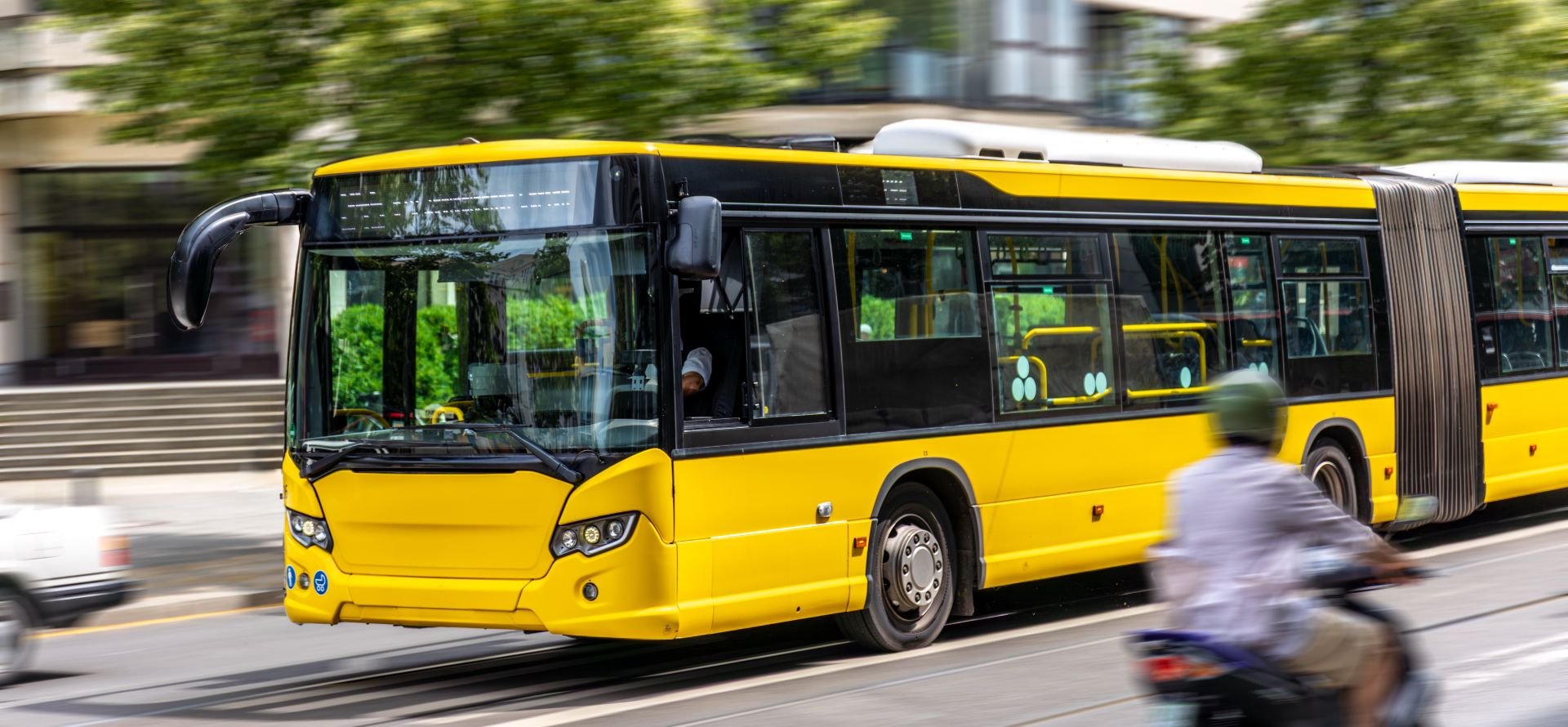
Public transit buses often rely on multiple onboard cameras to monitor the road, passenger areas, doors, and vehicle surroundings. While these bus camera systems provide valuable footage for security and incident review, many existing deployments were designed primarily for recording rather than real-time video analysis.
As transit operations become more connected and data-driven, AI video analytics can turn these existing camera feeds into actionable information. The challenge is how to add this intelligence without unnecessarily replacing cameras, cabling, and other infrastructure that is already installed and working reliably.
How Can Existing Analog Bus Camera Systems Be Upgraded with Edge AI?
The SINTRONES IBOX-601-TVI8 Edge AI computer enables public transit operators to add onboard AI video analytics to existing analog bus camera systems without replacing compatible installed cameras and cabling. Supporting up to eight TVI/AHD/CVI analog camera inputs via BNC connections, the IBOX-601-TVI8 integrates NVIDIA® Jetson Orin™ computing for onboard AI inference. With compatible AI software, the platform can support applications such as driver fatigue detection, pedestrian detection, and passenger-area monitoring. Specific capabilities depend on camera placement, video quality, AI models, and system integration.
Application Overview
|
Application |
AI Video Analytics and Driver Fatigue Detection for Public Transit |
|
Challenge |
Adding real-time AI analysis to existing analog bus camera systems without replacing installed cameras and cabling |
|
Solution |
IBOX-601-TVI8 with native 8-channel analog camera inputs and NVIDIA® Jetson Orin™ onboard AI computing |
|
Camera Support |
Up to 8× TVI/AHD/CVI analog cameras via BNC |
|
Key Value |
Reuse existing camera infrastructure, process video onboard, and simplify fleet-wide AI retrofits |
Why Existing Bus Camera Systems Are Difficult to Upgrade for AI
Many public transit buses already operate with multiple analog cameras connected through established BNC cabling. These systems can remain reliable for years, making complete replacement difficult to justify simply because new AI capabilities are required.
Moving to an entirely new camera architecture may involve more than replacing the cameras themselves. It can also require new cabling, network equipment, power integration, system configuration, and installation work across each vehicle.
At fleet scale, these changes add cost and deployment complexity while potentially taking buses out of service during installation. A practical AI upgrade therefore needs to consider not only computing performance, but also how much of the existing bus camera infrastructure can continue to be used.
Turning Existing Analog Camera Feeds into Real-Time AI Insights
Traditional bus surveillance systems are largely passive: cameras capture what happens, video is stored, and footage is reviewed after an incident. AI video analytics changes this workflow by allowing camera feeds to be analyzed as events occur.
Different camera positions can provide inputs for different AI applications when paired with compatible software. Forward-facing cameras may be used for vehicle, pedestrian, and road-object detection; side-facing views for activity around the bus; driver-facing cameras for driver monitoring and fatigue detection; and door-area or interior cameras for boarding-area and passenger-space analytics. Actual functions depend on camera placement, image quality, deployed AI models, and system integration.
Instead of treating each camera only as a recording source, AI turns existing video into data that can be interpreted in real time. Detection results can then be used to generate events, alerts, or metadata for other onboard or fleet systems.
The SINTRONES IBOX-601-TVI8 Edge AI computer enables this transition by connecting up to eight compatible TVI/AHD/CVI analog cameras directly via BNC and providing NVIDIA® Jetson Orin™ computing for onboard multi-camera AI inference. Application-specific detection and alerts require suitable AI software integration.
Why Video Analytics Should Be Processed Onboard the Bus
Sending multiple raw camera streams continuously over a mobile network for remote AI processing creates practical challenges for a moving public transit vehicle.
Video requires significant bandwidth, particularly when several cameras are operating simultaneously. Network quality can also vary along a bus route, making continuous cloud connectivity difficult to guarantee. For applications that depend on timely detection, sending video to a remote platform and waiting for analysis can also introduce unnecessary latency.
Onboard edge AI changes the architecture by processing video close to where it is generated:
Camera feeds → Onboard AI processing → Detection and metadata → Connected fleet systems
Only relevant results, events, or selected data need to be transmitted when required, rather than relying on continuous upload of every raw video stream.
With NVIDIA Jetson Orin processing directly onboard, the IBOX-601-TVI8 provides the computing layer for real-time multi-camera analysis while reducing dependence on network availability for core AI inference.
Retrofitting AI Without Rebuilding the Existing Camera Infrastructure
For an existing bus fleet, an AI upgrade does not necessarily need to begin with camera replacement. If the installed cameras, BNC cabling, and vehicle infrastructure remain functional, retaining them can significantly simplify the transition.
A retrofit architecture can instead focus on upgrading the intelligence layer:
Existing Analog Cameras → SINTRONES IBOX-601-TVI8 Edge AI Computer → Compatible AI Video Analytics Software → Operational Insights
This approach avoids introducing additional conversion devices or rebuilding the entire camera network solely to gain AI processing capabilities.
Native support for up to eight analog camera inputs allows the IBOX-601-TVI8 to sit directly between the existing camera infrastructure and the new AI application layer. Its 9–60VDC wide-range input, smart power management, ignition control, and rugged fanless design further support integration into existing vehicle environments.
By changing the computing layer rather than the entire camera architecture, transit operators and system integrators can introduce AI with fewer infrastructure changes and a more manageable fleet-wide deployment path.
From Passive Video Recording to Real-Time Transit Intelligence
The value of adding AI to an existing bus camera system goes beyond upgrading surveillance technology. It changes when and how video can contribute to transit operations.
In a conventional system, footage becomes useful primarily after an event:
Record → Store → Retrieve → Review
With onboard AI video analytics, the workflow can become:
Capture → Analyze → Detect → Respond
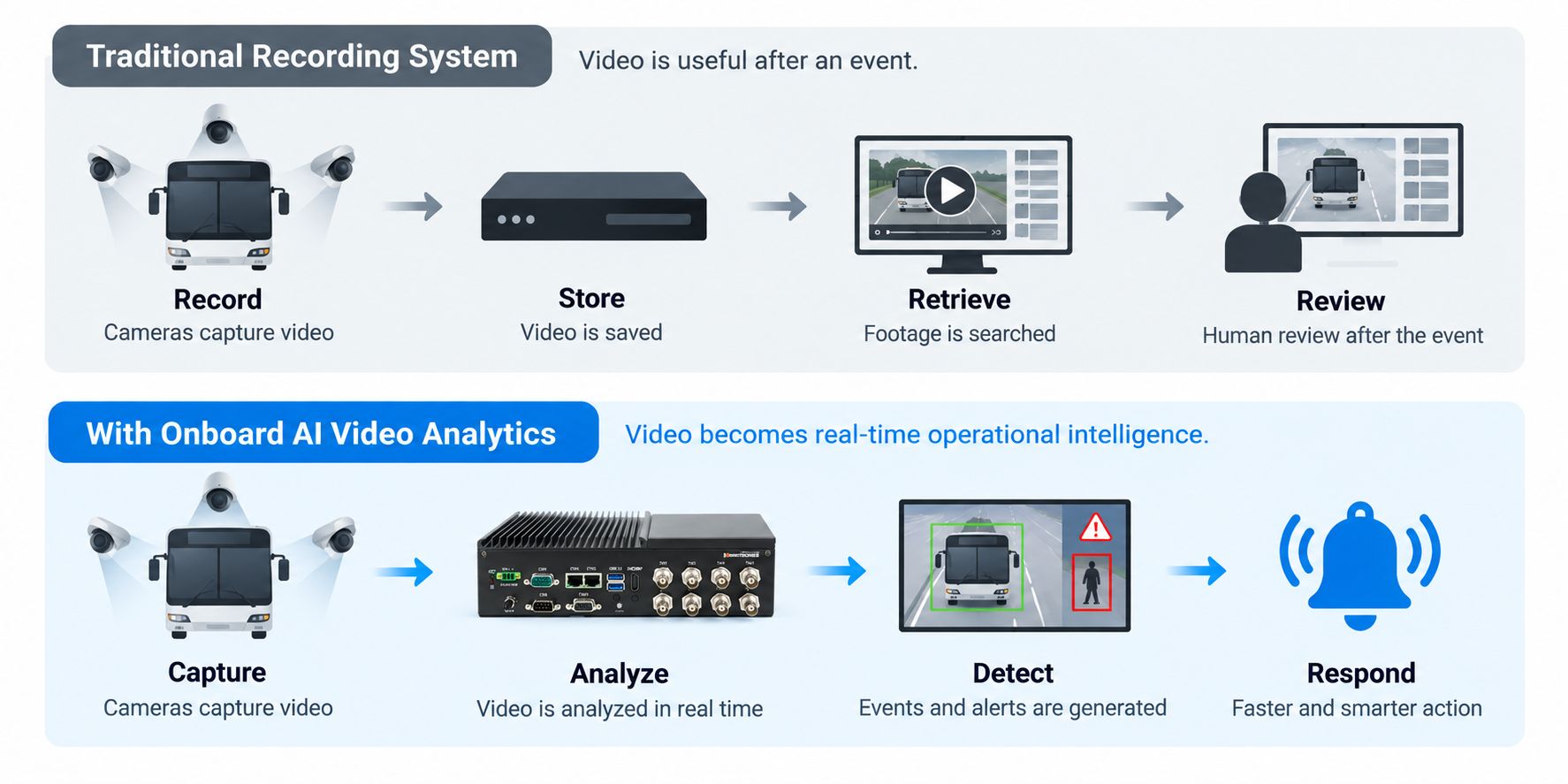
This transition allows existing camera infrastructure to support real-time awareness while continuing to serve its original video monitoring role.
For public transit fleets, the retrofit approach can extend the value of existing analog cameras, reduce the complexity of replacing installed infrastructure, and minimize disruption during AI deployment. At the same time, processing video onboard creates a foundation for faster detection and more intelligent use of camera data across connected transit operations.
Rather than rebuilding a working bus camera system, operators can preserve what already works and upgrade the intelligence behind it.
Frequently Asked Questions
Can existing analog bus cameras be upgraded with AI without replacement?
Yes. The SINTRONES IBOX-601-TVI8 Edge AI computer can connect to compatible existing analog cameras via BNC, providing onboard AI processing without requiring replacement of those cameras and cabling.
How many analog cameras can the IBOX-601-TVI8 connect to?
The IBOX-601-TVI8 supports up to eight TVI/AHD/CVI analog camera inputs via BNC. Simultaneous AI workload capacity depends on the computing configuration, video streams, and deployed models.
Why use onboard Edge AI instead of cloud-only video analytics?
Onboard AI inference reduces dependence on continuous mobile network connectivity and can limit transmission of raw video by sending relevant events or metadata instead.
Does the IBOX-601-TVI8 include driver fatigue detection software?
The IBOX-601-TVI8 provides the Edge AI computing hardware. Driver fatigue detection and other analytics require compatible software, models, and system integration; they should not be assumed to be built-in features.
Keep the Cameras. Upgrade the Intelligence.
Explore how the SINTRONES IBOX-601-TVI8 can add onboard AI computing to your existing analog bus camera infrastructure. Contact SINTRONES to discuss compatibility and integration requirements.